Transcript
00:01This presentation is going to be an overview on use of high voltage test equipment to test
00:06aerial lifts.
00:08This is a popular application for AC and DC high voltage test systems.
00:15In this presentation, we're going to review what is an A lift device?
00:19When are they used the testing of a lift devices and how hypotonic supplies necessary
00:24equipment for the proper testing of these a lift devices.
00:31Aerial lifts or bucket trucks are used frequently in utility work,
00:35vegetation management and in infrastructure maintenance.
00:39Aerial lifts are useful tools for companies that do work at r elevations but this often
00:45puts their workers in hazardous situations such as near energized power lines.
00:51There are three categories of aerial lifts that are the most common for utility and high
00:56voltage work category A B and C.
01:00In addition, there are also category de insulated area ladders and insulating vertical
01:05towers. Category A.
01:08Aerial lifts are used for bare hand work. And so the boom insulation is the primary form
01:13of insulation category. A area lifts also have a lower test electrode
01:18system. Category B area lifts are similar to category A
01:22but the boom is not considered primary insulation and so work in a category B device
01:27requires the use of gloves, live line tools and other personal protective equipment.
01:31Category C area lifts are very common for most distribution work and the boom is not the
01:37primary insulation, meaning that work done in a category C area lift must be done using gloves
01:43and other P pe category C devices do not have a lower test electrode system.
01:50Aerial lift devices come in different sizes and boom designs to meet the challenge of working
01:55at heights. There are two main types of boom design,
01:59articulated and telescopic articulated booms fold out to reach the desired height and fold
02:05back onto itself. When in transport, telescopic booms expand to
02:09the reach the desired height and retract for transport.
02:13Some of the larger aerial lift devices may feature both designs.
02:21Aerial lift devices may put workers in close proximity to dangerous high voltage lines.
02:26Aerial lift devices or bucket trucks with electrical insulation are to protect the worker
02:31in the bucket that were operators of the vehicle and those working near the vehicle
02:36electrocution is one of the leading killers for those in vegetation management and is a very
02:40real danger to linemen and other trained personnel who use bucket trucks to make sure
02:45that the insulation is still adequate to protect the workers.
02:47The installation must be tested regularly and properly.
02:51There are industry and safety standards to act as guidelines to make sure aerial lift devices
02:55are tested properly.
03:00Most companies have their own test procedure that are based either on the A NC 92.2 or IEC
03:0761 813 standards.
03:10Other standards such as the ocean 19 10.67 also provide guidelines on how to test aerial lift
03:16devices. Most standards call for three types of tests,
03:20design tests, qualification tests and periodic tests.
03:26High voltage testing is performed on insulating booms, chassis insulating systems,
03:31insulating liners and upper control components.
03:34Aerial lifts should be tested at minimum once per year and after any repair or replacement of
03:39components at cross insulating systems such as hydraulic hoses,
03:43boom coatings and the like.
03:49This chart is from the A NC 92.2 standard and it details the correct testing parameters for
03:55design and quality testing. The insulation of insulated booms for category
03:59A and B aerial devices.
04:07This chart is from the NC 92.2 standard and it details the correct testing parameters for
04:13design and quality testing, the installation of insulating booms for category CD and E devices
04:19as well as the test parameters for design and quality testing for insulating aerial ladder
04:23and insulating vertical aerial towers.
04:29This chart is also from A SC 92.2 and details the guidelines for periodic testing of
04:34insulated booms for category A and B aerial devices.
04:43This chart is from NC 92.2 and it details the guidelines for periodic testing,
04:48insulating booms for category CD and E aerial devices as well as insulating aerial ladders
04:54and insulating vertical aerial towers.
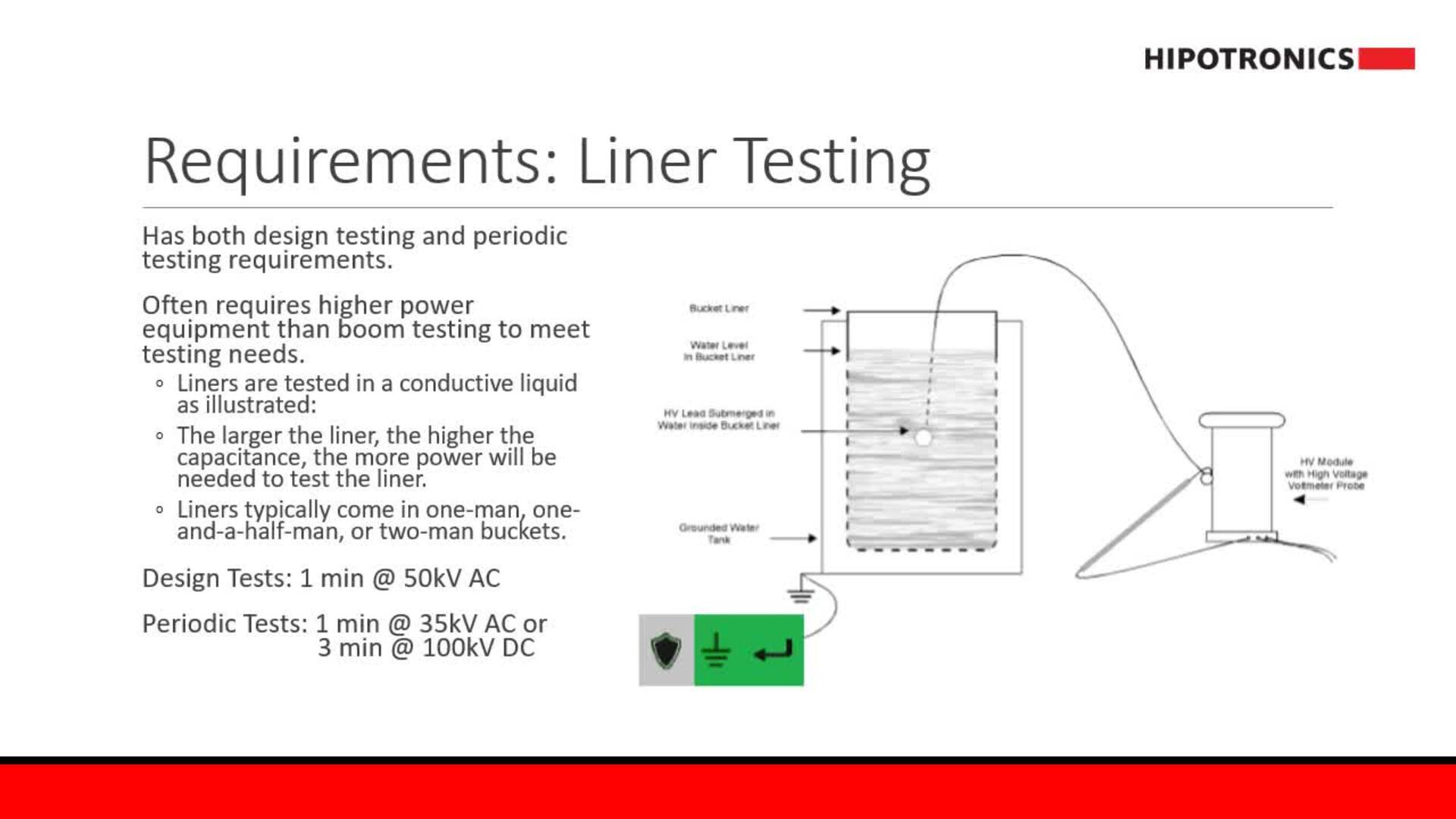
05:01In addition to the boom insulation testing, the liners that workers stand in must be tested.
05:06Liner testing often requires higher power test systems than boom testing due to the use of
05:11conductive liquids to ensure that there are no holes in the liner.
05:15This test has no leakage current requirement.
05:18The voltage must hold for the allotted time.
05:27Another component that needs testing is the upper control components.
05:31This the insulated pieces surrounding the controls.
05:35This is a more difficult test to set up since additional materials such as an insulated
05:39blanket may be needed to prevent arcing to materials that are not under test watch for
05:44surface tracking along nearby fiberglass and other nearby surfaces.
05:52Chassis insulators must also be tested to ensure safety to those working near the vehicle.
05:57Chassis insulating systems are to protect personnel if energized conductor comes into
06:02contact below the boom installation, chassis insulating systems have both design quality and
06:08periodic testing criteria as well.
06:17When testing the dielectric strength of insulation on bucket trucks,
06:20it is important to note whether an AC hypo test is needed or a DC hypo test is needed.
06:26AC high pot testing is necessary for design or quality testing.
06:30While DC hy pods can be used for periodic tests.
06:33Another key difference is that AC high pod testing will measure both real current and
06:38reactive current. Whereas the DC test will only measure the real
06:41current. An AC high pot test will almost always show a
06:45higher leakage current than a DC test.
06:54This diagram is an image of the A NC 92.2 standard and it illustrates the connections for
07:00testing a category A or B aerial device.
07:05Do you know that shunting jumpers should be placed over joints and the chassis insulating
07:10system. This test is done with the chassis of the
07:13aerial device grounded when performing a test like this.
07:16It is important to set up your high pod tester for a grounded test object.
07:25This diagram is an image in the A NC 92.2 standard and it illustrates the connections for
07:30testing a category C aerial device.
07:32This diagram is for testing. The aerial device is in a floating mode,
07:36meaning ungrounded note that shunting jumpers shall be placed over joints and chassis
07:41slitting systems similar to the previous diagram.
07:44Key differences is that the aerial device is ungrounded, insulated from the ground using
07:49insulated platforms under the wheels and out breakers, make sure that when doing a test in
07:54this configuration, the high pod tester is set up for a testing a floating test object.
08:03This diagram is also an image from a NC 92.2 standard and it illustrates the use of shunting
08:09jumpers for testing the chassis insulating system.
08:12When testing the chassis insulating system, it is recommended to test in a floating mode
08:16similar to testing category C aerial devices.
08:24This diagram is an illustration of the description given an C 92.2 for testing bucket
08:30liners using a conductive liquid.
08:32The bucket liner is placed in a grounded water tank and the conductive liquid is placed inside
08:37a liner. The high voltage output is then placed in the
08:41liquid and the voltage is brought to the necessary testing voltage.
08:45If the voltage holds, meaning the high pod tester did not trip due to short circuit,
08:49then the test is passed.
08:56This diagram is a simplified schematic depicting the testing circuit for testing.
09:01The upper control components.
09:03One is the high voltage source making connection to two which is the operator side of
09:08the insulator. 34 is the boom side of the insulator which is
09:12connected to five the current meter.
09:15This area can be tight spatially and may require a dielectric blanket or other insulator
09:19to prevent surface tracking to nearby surfaces.
09:27Hypotonic designs and manufacturers vary equipment from both AC testing and DC testing
09:32for aerial lift devices. These include but are not limited to the HVTD I
09:38series, the 700 D I series, the MS R 880 PL dash HD
09:45and the 8175 PL.
09:54This table illustrates the various product offerings made by hydronic for aerial lift
09:58device testing and shows which each product offering is capable of testing according to the
10:04NC 92.2 guidelines.
10:12This presentation is an overview on high voltage testing of aerial lift devices.
10:17If you or your organization has questions on aerial lift device testing or is interested in
10:22high voltage test equipment for testing aerial lift devices,
10:25please contact a hypotonic sales engineer by calling our sales line at
10:298452309245. Or send an email to sales at
10:35hypotonic.com.

Hipotronics Aerial Device Testing 2020 | Webinar
- private