Transcript
00:04This presentation will be covering material and oil breakdown testing.
00:08And we'll go over the D 149 D I series and the OC six D I series systems that are offered by
00:14hypersonics. First, we'll go over uh
00:21small overview of the breakdown testing uh for material and oil and then we'll compare
00:26breakdown testing versus high A testing.
00:30We'll then go over the D 149 D I features and the specifications.
00:34I'll show the screens, uh a little preview of the screens of the software that comes with the
00:38system as well as the advantages of the new D 149 D I series over its predecessors.
00:45I'll then mention some of the implications that can be,
00:49that can be done with the D 149 D I.
00:52We'll then move on to the OC six D I feature some specifications.
00:56I will again show some of the screenshots that are visible on the system as well as uh go over
01:02the advantages of the new OC six D I over the previous versions of the OC 60 series.
01:09We'll finalize that with the common applications that the OC six CD I is used for
01:16for material breakdown testing. It's uh to deter determining that the electric
01:21breakdown voltage of solid insulating material is necessary to understand the material's
01:25ability to withstand electrical stress without failure.
01:28Uh The breakdown test can be performed by increasing the voltage uh until there is an
01:32actual failure of the insulating material and the voltage can be increased in three different
01:37ways. The short time test, which is a rapid test,
01:40a slow rate of rice test and a step by step test.
01:44The main international, the main uh standards that are followed for this type of testing is
01:49the A SD MD 149 and the IEC 60243, the A SD MD 149 is mainly followed in the
01:56US. While the international community uses the IEC
01:5860243 standard as a guideline for oil breakdown testing.
02:05Uh The same thing uh is necessary to do essentially.
02:09Uh you wanna do um put the oil to a stress test uh until
02:16it actually fails, the breakdown test can be performed by raising the voltage continually
02:20over time until there is an actual failure.
02:23And the main standards that are used in the US uh are the A SD MD 1816 and the A SD MD
02:30877.
02:31Uh the, the A SD MD 877 is starting to be phased out more or less and they,
02:38we're focusing more on the A SD MD 1816.
02:42Uh World International community follows the IEC 60156.
02:47Do you know that many countries do have their own local standards?
02:50However, most of those standards are based on either of these standards,
02:57breakdown testing versus high blood testing. Um For breakdown testing,
03:01the high voltage uh test is done to failure.
03:04Uh It's usually a destructive test and therefore it's only done as a sample test.
03:09Uh It's usually used for testing materials, uh insulating materials and the test will always
03:14result in a flash over since that's the goal of the test.
03:18Uh With this in mind, the breakdown testing equipment is usually designed to withstand
03:22thousands of flash overs in the life span of the unit in hypo testing.
03:28On the other hand, uh the high voltage test, it's only done to a certain withstand voltage
03:33level. It's usually non a non destructive test unless
03:36the, the item that you're testing actually fails.
03:39In which case, it becomes a destructive test.
03:42The Hypo testing is usually done for acceptance testing or routine testing and is usually used
03:46for testing pool systems.
03:49Uh You will only observe a flash over during hyper testing when the item that you're testing
03:54actually fails. Uh And therefore, the Hypo testing equipment is
03:58designed to protect itself uh in case there is a flash over.
04:01Nevertheless, it's not designed in particularly uh for repeated arcing or flash overs.
04:10The D 149 D I series. Uh now has a digital interface with touchscreen
04:15controls. Uh It has preloaded D 149 test parameters in it.
04:20And uh and then it can also be adjusted uh for cost test.
04:24Uh In case the operator wants to do a certain specific type of test.
04:29Uh The system also has automatic calculations and, and with once the tests are done and you
04:35can export the data uh via reports on the US via the USB 2.0 that's in the control,
04:43the system and controls can also be updated uh specifically the software uh via the USB.
04:48And now this system, we also offer them with uh DC output voltage as well as corona free uh
04:54output. Uh the 75 KB and 100 KB versions do have a
04:59shelf uh available uh which allows to store some of the accessories that are used on during
05:05the test. The system breakdown voltage detection is
05:10within 10 microseconds and one of the main uh new features or improved features of the D 149
05:17D I series is that it now has a single tap configuration that allows the operator to test
05:22from 0.5% to 100% of the rated voltage.
05:26Uh As I had mentioned before the system, although comes with preloaded D 149 tests,
05:32uh The operator can also adjust any of the test parameters.
05:36Uh Both versions of the system. Uh the smaller version which is shown here and
05:41the larger 75 100 KV versions do come with a built in safety cage window and it's designed
05:47with a continuous to recycle for breakdown testing.
05:50This unit also has one of the highest accuracies in the market right now.
05:54Uh with a 1.5% of reading plus minus 0.2% of full scale.
06:00Here, we can see some of the software windows that are that you would observe on this,
06:05on the equipment uh on the top. And you can see the main menu screen on the
06:09bottom left. You can see the essentially the,
06:12the screen where you will set the, the test parameters uh either by recalling a certain
06:19test or just by clicking on each each uh value and then changing the
06:26value to your uh to the desired value that you're trying to test.
06:29Uh Once you press the start, uh the screen will switch red to indicate that a high voltage is
06:35on and the values will change as the test progresses.
06:38Uh the, as the test progress, you will see the number of tests and the breakdown voltage on
06:43the right side. And then once the test ends, um you will be
06:47able to export all that data via the USB.
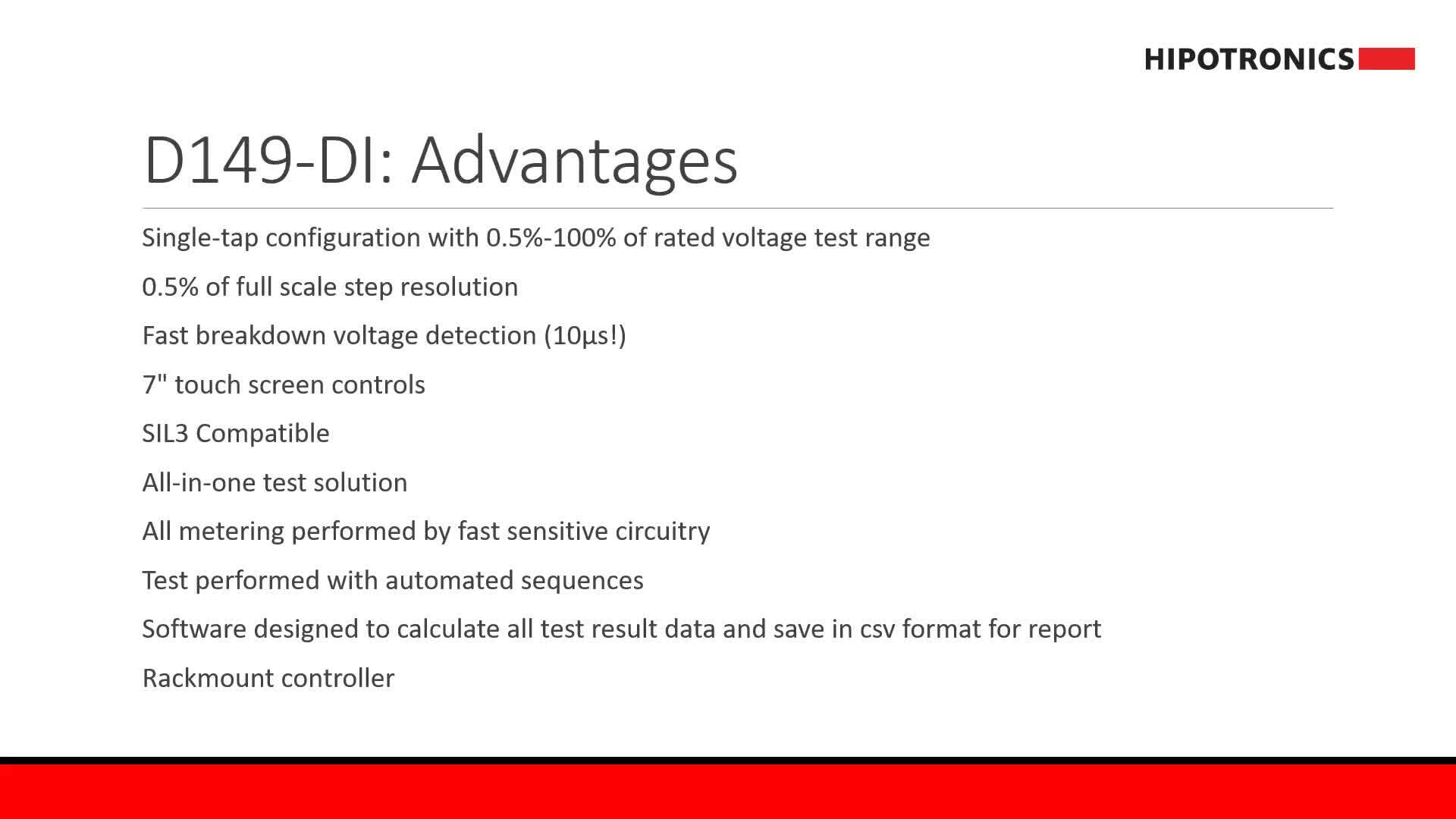
06:55The D 149 D I series has. Uh the new control allows uh to have more
07:00advantages over the older versions of the system.
07:03The main ones I had mentioned before is a single tap configuration with a 0.5% to 100% of
07:08the rated voltage test range.
07:10Um And then it also has a 0.5% of full scale stepper solution.
07:15Uh The, it has a fast breakdown voltage detection of less than 10 microseconds.
07:20And the new screen, the touch screen is seven inches uh long.
07:25OK. Uh It also has ac through compatibility uh
07:29which allows for uh safety features uh as that are necessary nowadays.
07:34Um This system also is uh is essentially an all in one test solution,
07:39especially if you wanna do uh some DC testing or partial discharge testing as well.
07:45All the metering is performed by past sensitive circuitry and the test performs uh with,
07:50with automated sequences.
07:52The software itself is designed to calculate all the test result data and save it into a US
07:58into the control, internal memory or, and then exported via USB and CS D format,
08:06the control. So R mo control allowing for future upgrades.
08:09Um Once they come out, the D 149 D I series can be used to
08:16test polymeric moldings, embedding compounds, ceramics, tubes,
08:20sheets, rods, varnishes, coatings, adhesives or any filling compounds,
08:24essentially any type of uh insulating material uh that you're trying to do some electrical
08:28testing with the D 149 D I is usually seen in
08:35insulating material and electrical safety equipment manufacturers as well as in
08:39laboratories. For renewable energy and battery research and
08:42development, uh chemical manufacturers as well as of aerospace and parts and auto parts
08:49manufacturers. Uh do use this type of system.
08:55Now, the OC six CD I um it's the new version also as well,
08:59the oil breakdown testing system that we have released.
09:03Uh And uh it also comes with a digital interface with the touchscreen controls.
09:08Uh It has automated testing for preloaded uh national and international standards which I
09:13had already mentioned before.
09:15Um If the customer doesn't have uh if, if the customer's standards that they're trying to
09:20test or are not preloaded into the system, the customer will still be able to uh upload
09:25different uh test parameters into, into the controls.
09:30The system also has uh automated reporting and uh calculations uh such as the standard
09:37deviation which, which makes makes it easy for the operator to be able to uh report the
09:42results. Once the tests are done, you can export the uh
09:46the results via the USB or via the optional onboard printer.
09:50Uh The system does, the system does keep the, it's, it's uh it's durable metal case which has
09:56been in uh in past versions uh which makes it uh more sturdy.
10:02Uh The software of the OC six D I can also be updated via the USB port uh as well as uh
10:10uh to explore the data uh via the USB.
10:13It comes with the easy graph handles which makes it easier to move uh from location to
10:17location. And it has a translucent titan shield uh which
10:21also has a magnetic interlock uh for safety reasons.
10:26This way, if you uh slide open the the shield, the high voltage of the OC 60 D I will
10:32automatically stop. Uh The system now comes also with a battery uh
10:36included, which uh which allows for on site testing.
10:41And uh the break uh there is an automatic highball to shut down within 10 microseconds of
10:46the break breakdown point.
10:48The system's accuracy is 2% of full scale and it also has universal mains input which allows
10:54for adjustable output frequency.
11:02Here, you can see the screens of the OC 60 D I software on the left side,
11:05you can see again uh the, the values that are gonna be that are set uh for the test.
11:12Uh You can upload the preloaded test sets uh or the the standards,
11:17whether national or international standards uh by clicking on the clip or on the bottom.
11:22And then you can choose the standard that you're trying to test to in case the standard
11:27is not pressed or preloaded into the system.
11:30Then you can just click on each of the values that are seen in the screen and then you can
11:34fill those out as necessary.
11:37Once you uh you have the values uploaded, uh you can just press start and the screen will
11:41switch to red again uh to show to the operator, the high voltage is on as the test progress
11:48progresses. Uh the values on the right side will,
11:51will keep changing as the each test is is finalized.
11:55Uh You'll be able to see that uh the values of the breakdown will appear on the on the graph
12:00on the right side. Uh Once the test is done,
12:03all the values are automatically calculated and can be exported via USB or printed uh via the
12:08optional printer. Apart from the OC six TD I,
12:13you will also require test cells to be able to um to be able to hold the oil that,
12:19that will be tested.
12:20Uh We have changed the way that we sell the test cells in hypersonics.
12:24Uh We now offer uh a one cup that's uh that can be uh
12:30adjusted with all the electro kits. So essentially you will require the cup as as
12:35well as one of at least one electro kit.
12:38Um In this case, we're showing you here the uh 81816 which is the kit for the A ST
12:45MD 1816.
12:47We also have the 150 for the electro kits for the one IEC 156 and the A
12:54ST MD 877.
12:56Uh The main difference between these standards is the electrodes uh with the 877 having
13:03black electrodes while the other two have BD A electrodes and the A ST MD 1816
13:09requires a ST.
13:11Uh So therefore, it also includes uh ac uh motor driven circulating system on the cap of
13:18the that cell. We also offer the OCCME which is a digital
13:23calibration test cell. And it allows to calibrate the voltage as well
13:27as the ramp rate of the OC six CD I, the
13:34OC 60 D I. Now, this is the modern replacement of the OC
13:3760 series. Uh It's compact design.
13:40Uh It allows for multi-purpose use uh whether in the field or in a factory or laboratory.
13:46Uh As I had mentioned, uh we did keep the sturdy and reliable casing for it for the
13:51system uh which customers have appreciated very much.
13:54And uh the touchscreen interface is very much user friendly also as well.
13:59The battery that that's now uh included as a standard feature uh allows for testing in field
14:05uh as well as the easy to share the results via the USB or by printing the results.
14:13UC six D I is actually used to do any sort of dielectric breakdown testing on insulating
14:18liquids. Uh Most of this, the liquid is usually oil and
14:22any essentially essentially any uh equipment that uses oil as an insulating liquid uh would
14:29be used, will will need to be used uh or we need to go through the testing.
14:33Uh When you're testing the oil, uh this type of equipment is usually transformers,
14:37pushings, switch gears, capacitors, hydraulics, yeah, circuit breakers and reclosing
14:45the OC six CD I is usually seen uh in the utility companies,
14:49uh utility contractors and laboratories uh as well as transformer repair shops and service
14:54centers. Uh Additionally, uh transformer manufacturers,
14:57as well as switch gear and capacitor manufacturers also uh can use the OC six D I uh
15:01to test that the oil that they're using.
15:08If you have any questions regarding uh material or oil breakdown testing,
15:11please do not hesitate to contact us uh as well if you have any questions uh regarding uh the D
15:16149 D I series or the OC 60 D I series as well. Uh You can contact us by calling us to our
15:23sales number or by emailing us to sales at hypertonic.com.
15:28Finally, you can also go to our website uh where you can find the data sheets for all of
15:32our equipment as well. Uh Again, um don't hesitate to contact us if
15:37you have any questions. Uh And thank you.

Hipotronics Material & Oil Breakdown Testing D149-DI & OC60-DI | Webinar
- private